Revolution BJJ Logo

    Richmond, Virginia's BJJ home     2125 Staples Mill Rd
    Richmond VA 23228
    804-657-7461


Pages

BJJ Revolution Affiliates


US Grappling

Big Man BJJ

20 of January 2012

My goal from the beginning was never to be recognized as “the big guy” with my training partners.  That sounds ridiculous since I’m almost always the biggest guy on the mat when I train, but truthfully I try not to be.  I train BJJ because I want to learn the art, not lay on top of people or toss them around because I’m so much bigger or stronger.

Besides that, just because you’re bigger, sometimes way bigger, doesn’t mean you can be effective.  I assure you there are lots of folks at this gym that give me problems and the occasionally butt whipping even though I have 80 pounds or more on them.  I guess being “the big guy” is unavoidable most days so I try to be the most technical big guy I can.

This presents a couple of challenges.  First, there are some positions that I don’t train that often because, well, I don’t want to hurt anyone.  I’m not going to go to knee on belly with my training partner unless he’s about the same size as me or I know I present no real threat due to their ability to escape (thanks Vince!)  Second, I’m always second guessing myself when I do get a position, finish a submission, or escape.  “Did I get that because I’m bigger and stronger or did I get that because I executed great technique?”  Both of these things really matter to me.  When I do encounter a training partner or opponent that is my size I want to be confident that I’ve worked on my technique and strategy to a degree that the size becomes irrelevant.

The way I’ve dealt with this in my training is to really try and play a “little man’s game”.  I like to pull guard, play half guard, play with leg locks, and catch people with sneaky submissions that rely on technique.  That helps me focus more on my technique.  Of course, there are always times when I’ll get frustrated or even scared and use my size as an advantage, but I honestly try and keep that to a minimum.  I’m sure I do it more than I think.  Ultimately, though, I’m still learning and whether or not I got a technique because of size or efficacy I’m helping my training partner get better too.

For the record, when someone says, “you are so heavy or strong or big,” it’s not a compliment, just an oberservation of phyisics.  Hah!


—————————————

Mark Pushinksy is a purple belt at Revolution BJJ, a business owner, and a father of two.

Have you ever played solitaire on your computer? Ever notice that you don’t really scan every individual combination of cards when you are presented with a new set of three cards? Instead, you tend to hover the mouse over the deck, ready to click to the next set of three cards very rapidly. You are able to do this because you are able to generalize: red cards must be paired with black cards, so that limits a certain percent of the possible moves; the next number up from any card is of desired interest.

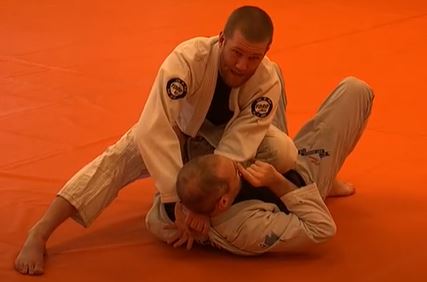
The same thing happens in jiu jitsu: you tend to make broad generalizations about similar situations, and that helps you recognize patterns.  One simple example of this is when you first start training jiu jitsu, you will typically tend to try and memorize things you’re not supposed to do in certain situations.  Quite frequently, this is called posture.  One obvious example is that you don’t normally ever want to try to go for an Americana while inside the other person’s guard, especially their closed guard.  Another might be that you don’t ever want to have your hands on the mat.  Both of these are pretty specific in nature- things not to do while rolling- but if you are able to lump them together into a broader category of what to do- hands go in a specific region of the person’s torso while in the guard, elbows stay in- you can start to make progress toward a deeper understanding of the underlying principle of the position, not just memorization.

It will eventually click (if you keep doing BJJ for long enough) that you have to keep your elbows in close to your body (generally speaking) whenever you are in a dangerous position.

An even broader example of this might be the simple but elusive concept of base.  Taking away a person’s base allows you to sweep them easily, but at first, you must learn a specific set of sweeps that work.  Just as you have to learn the rules of any game you play by first examining the way specific actions happen (moves in chess, plays in a team sport, or techniques in BJJ), you must first learn a select handful of specific sweeps.  If you sit up into your partner and find them to be leaning backward, you can execute an easy hip sweep (hip bump sweep, as it is sometimes called).  If they defend that, you might find that a Kimura (shoulder lock) from that position makes more sense because they’re forced to base.  If they drive back into you from there, you might find that a guillotine choke works best.    All three of these positions are from “armpit on shoulder” position from closed guard, and there are hundreds of other positions like this, from which there are multiple high percentage attacks.

In every one of these techniques lies a fundamental concept you can discover.  If you start thinking deeply about it now, you might make these discoveries sooner rather than later.

If you’ve been training for a while now, you’re probably excited to be trying out new techniques.  Berimbolos, deep half guard sweeps, reverse De la Riva guard techniques… these are all terrifically fun BJJ chess moves to figure out.  Very few things feel better on the mats than executing something you just learned how to do last month.

However, jiu jitsu offers a great deal more than just flowing through complicated, advanced techniques.  Rolling with new guys on a regular basis is incredibly important to you.  Here’s why:

1.  Practicing the basics
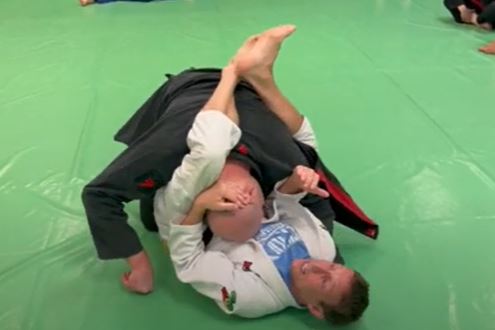
This is an often-overlooked aspect of training- not simply because more advanced guys don’t think they need to work on their fundamentals, but rather because the brand new guy offers something the more advanced practitioner doesn’t:  the true beginner’s reaction.  When I roll with blue, purple, brown, and black belts, I enjoy playing all kinds of open guard, using intricate passing combinations, and chaining together submissions in order to try to finish the match.  However, with brand new guys, I get the opportunity to practice fundamental guillotine chokes, hip bump sweeps, and basic rear naked chokes on a regular basis.

2.  Unexpected reactions
Rolling with a new guy (or girl) is like a box of chocolates.  You really have no clue what kind of reaction you’re going to get when you try a technique.  Watching how beginners deal with your attacks can actually give you some great ideas as to how to adjust your game accordingly.  Ask yourself:  what did that guy do that frustrated me?  Why did it frustrate me?  Most importantly, how can I integrate this into my own game?

3.  Controlling the spazz factor
This might be my favorite thing about working with the jiu jitsu novice.  My style is a creeping, slow one that involves relatively little risk for injury for both me and my partner.  When you are faced with a brand new beginner, protecting yourself and them has to be paramount when you roll.  Learning to take care of your partner is extremely valuable in both the short and long term, and so is learning to slow down the spazz.  This attribute becomes reflexive after enough work with beginners.  When a blue belt suddenly flips out because you have caught him in a submission he hasn’t seen before, instead of injuring, you will have the familiarity with the position and be able to control the spazz factor.

One of the first real lessons you have to learn when you’re first starting Brazilian Jiu Jitsu is not to fight force with force.  ”Jiu jitsu” (or “ju jitsu”) literally translates from the original Japanese as “gentle art”, but it’s not because we all just want to slowly, gently hug one another on the mats; instead, the name describes the underlying philosophy of BJJ to a tee:  when faced with a worthy adversary, don’t try to overpower the force, but instead move around it.  When faced with something more powerful than you, get out of the way.  When pushed, pull; when pulled, push.

Brazilian Jiu Jitsu has changed my life immeasurably over the last 15 years or so.  My story will sound familiar to anyone else who has been training for more than a year or two, and it is my hope with sharing this story that many will understand that the philosophy applies not only on the mats, but also in real life.

It took a while for me to learn the lessons and actually apply them with life.  Like most young adults (early 20s), I was pretty angry a lot of the time.  I was passionate about social issues, politics, personal interactions with my friends, and just about anything else that presented itself to me.  I shook my fist at the establishment, wrote songs about how angry I was, and envisioned things changing one day, without any kind of concrete idea of how to make it happen- just a lot of angst.

When I started jiu jitsu, I gradually began to see things in a new light.  There were certain things that, no matter how hard I tried, I wasn’t going to change in the immediate future.  One example is the rather childish approach I took to owing money to the city for parking tickets.  I viewed the city’s overly aggressive approach to ticketing ignorant citizens like myself as wrong, and I refused to pay tickets.  Well, guess what?  I ended up owing a lot more money and going through a lot more angst because of my attitude.

Before I go any further, I need to make a disclaimer here.  I’m not suggesting that wanting to enact change is a bad thing, or childish, or foolish.  It’s not.  What’s immature – futile, even- is the attitude that you’re not going to go with the flow when faced with insurmountable obstacles.

As I grew older, I was frequently faced with analogous examples in my personal and professional life where rolling with the punches (another term that aptly describes the BJJ philosophy, although I’m borrowing it from boxing here) would help me get through some tough times. The ability to shrug your shoulders and move forward when faced with a huge, unexpected bill, for example, is incalculably valuable. When a loved one betrays you, moving forward with life is made possible in many ways by realizing that life will move on with or without that person. Going with the flow lets you get on with your life, and even benefit from tough times in the long run. Retrospect is a powerful tool.

Bedroom ceiling

The best personal example that comes to mind is from about 2007 when I was living in a house that I loved.  The place was perfect for me at the time- spacious, historic (I love older houses), and close enough to everything in the city so that I could walk to a few places if I chose.  I had been at this house for about three years when a new owner purchased the place (I was renting).  Six uneventful months went by before the roof began to leak.  I reached out to the landlord on several occasions, and he said he would fix it, but (long story short) I got the runaround from him.  Things got bad enough so that it was essentially raining inside my house.  I eventually went to court, put my rent in escrow, and got it all back before moving out.  That rent money became part of a down payment on a house I would buy the following year.

Instead of bearing futile anger at the situation, I essentially allowed things to take their course.  Looking back, it was relatively easy to get my rent money back because I was patient, and I took the appropriate legal channels to accomplish what I needed.

The more time I spent on the mats, the better I understood that I had to get out of the way of certain things, both in life and on the mats.  The better I got at jiu jitsu, the better I understood that life’s waves are made to be ridden, not faced head on.  Enjoy your time on the mats, and take the lessons home with you.  It will make your life more enjoyable and productive.

Oh- and if you don’t understand the article’s title, please immediately watch the following video when you have an hour and a half to kill:

Aaron with his first BJJ teacher Julio "Foca" Fernandez

Author:  Aaron Lapointe, Carlson Gracie Jiu-Jitsu Black Belt

One of the best things about jiu-jitsu is that it can work for almost anyone as long as you put in the time and effort and make the proper adjustments. I’ll use myself as an example. Even though my right arm is fully paralyzed, I was still able to achieve my black belt in jiu-jitsu and compete in some of the world’s most prestigious tournaments. Sure I was fortunate to have learned from some of the biggest legends in the sport; I will talk about them in a separate write-up. Even so, a large part of my success was directly related to the fundamentals of jiu-jitsu and the inherent ability we all have to overcome physical and emotional roadblocks.

Sometimes an apparent limitation is a blessing in disguise because it pushes you to find the simplest and most efficient way of doing something. Whereas some people might perform a technique by following steps 1 through 5, someone who is unable to do steps 3 and 4 might discover that the same end result can be achieved in fewer or alternative movements.  Because the margin for error is much smaller when you have a disability, your movements need to be timely and precise. In addition, a significant limitation in one area can help promote a major strength in another. Because I was unable to use my right arm to stop people from passing my guard, I developed excellent hip movement, a strong grip, and proficient use of my hooks. I also had to develop a strong base and keen sense of balance so I would not be easily swept to my right. Most importantly, I acquired an advanced understanding of the basic principles that make jiu-jitsu work. For example, sweeps work because you disrupt a person’s base and prevent him or her from reestablishing it, not because you put your foot in a certain position or grab the collar in a specific way.

Aaron competing against Bibiano Fernandes at the 2004 Pan American Jiu-Jitsu Championship

Some people think my jiu-jitsu would be even better if I could use both arms. I’m not so sure about that. In fact I kind of doubt it. The only thing I do know is that my jiu-jitsu would be different, and most likely those areas that are essential to my game (e.g., hip movement) would be much less developed. Not only did my disability help shape my jiu-jitsu, but it also motivated me to train hard and establish a “never say die” attitude. Unfortunately, this drive and attitude was not always a good thing since the playful side of jiu-jitsu sometimes escaped me. Nowadays I train jiu-jitsu because it’s fun, not because I feel the need to prove myself on the mat.
If you train jiu-jitsu long enough you’re bound to roll with someone who has a physical disability. Heck, we all have physical limitations of one kind or another. Some are just more obvious than others. Regardless of what that limitation is, I offer these words of advice. Help that person work around his or her disability, but don’t feel the need to try and simulate it when you spar. If your partner only has one arm you don’t need to roll with one arm tucked in your belt. If your partner is blind you don’t need to roll with your eyes closed. If you outweigh your partner by 75 pounds, you don’t need to jump in the sauna. You get my point. Hopefully, many of you out there already adjust your games accordingly depending on who you are rolling with. Generally speaking, you don’t spar the same way with everyone, and if you do you may want to reconsider that strategy. If your partner has a physical limitation, refrain from making any special accommodations without asking first. Don’t worry, that person will be just fine. Jiu-jitsu will make sure of it!

Anyone with questions or comments for Aaron can reach him at aaronlapoi@yahoo.com.


« Older PostsOlder Posts »